For a nominee / beneficiary
You may be named as a nominee on someone's accounts or policies. This explains what that means — and, importantly, what it does not.
Not legal advice. Rules differ by country and by asset type; confirm with the institution and a qualified professional.
Nominee vs. legal heir#
- A nominee is the person the account/policy holder named to receive and hold the asset when they pass away. The institution will release the asset to the nominee — this makes the process fast and avoids the money being stuck.
- A nominee is generally a trustee/custodian, not automatically the final owner. Who ultimately inherits is decided by the will, or — if there is no will — by the succession laws that apply.
- So you may legitimately receive an asset as nominee and still be obliged to pass it to the rightful heirs per the will/law. (Some assets, like certain insurance payouts to specific family nominees, can vest more fully — this varies; check.)
What you'll typically need to claim as nominee#
- A death certificate (get several certified copies — almost everything needs one).
- Your identity/KYC documents.
- The account/policy number (in the inventory this person prepared).
- The institution's claim/transmission form — ask the contact listed in the inventory.
Where to find the details#
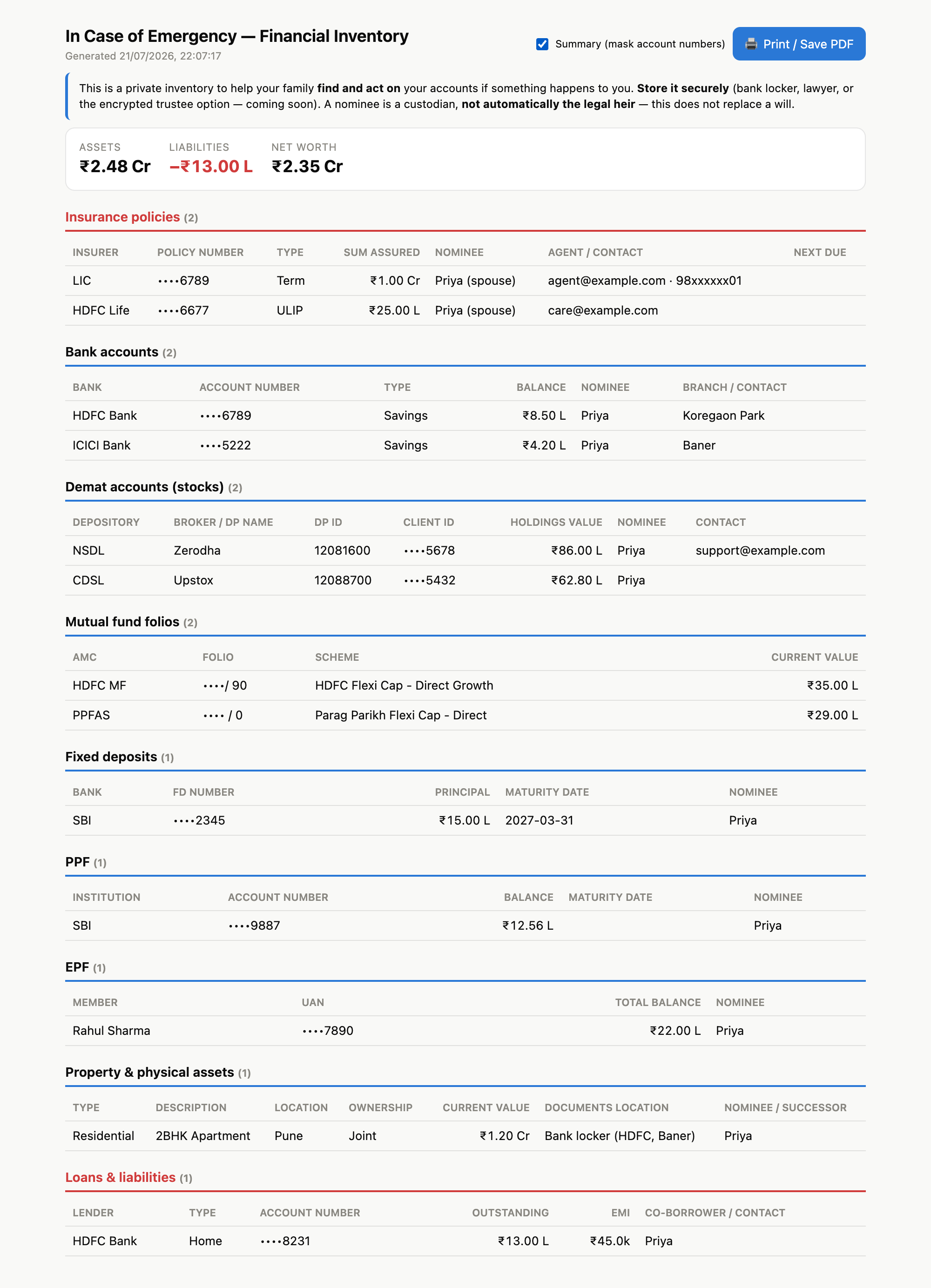
The person prepared an "In Case of Emergency — Financial Inventory" listing each asset, its nominee, and a contact (a summary version masks account numbers):
 If parts are hidden (a masked summary),
the full detail is in an encrypted report that the appointed trustees
can unlock together — see For your family and
For a trustee.
If parts are hidden (a masked summary),
the full detail is in an encrypted report that the appointed trustees
can unlock together — see For your family and
For a trustee.
Do this#
- Locate the will and the executor/lawyer — involve them early; they lead the legal process.
- Use the inventory's contacts to start each claim.
- Keep records of everything you receive as nominee, in case it must be distributed to heirs.