For your family
If you are reading this, someone close to you prepared it so you would not have to piece their finances together alone. Take a breath. Everything you need is here.
This guide assumes no technical knowledge. Work through it in order.
1. Find the inventory#
Look for a printed document titled "In Case of Emergency — Financial Inventory." It lists every bank account, insurance policy, investment, property, and loan, with the nominee and a contact for each. It may be in a bank locker, a home safe, or with the family lawyer. If you have access to their Google account, it is also the TraderTape Wealth spreadsheet in their Google Drive (open it and use the menu 🆘 Estate / ICE report).
2. Do these first (in this order)#
- Insurance policies — these are the most commonly missed and the most time-sensitive. For each life/term policy in the inventory, contact the insurer (the "Agent / Contact" is listed) and ask how to file a claim as the nominee. You'll typically need the death certificate and the policy number.
- Loans & liabilities — check the Loans section so you know what is owed. Contact each lender promptly; some loans are covered by insurance, and knowing the debts early prevents surprises.
- Bank accounts — contact each bank; as nominee you can usually claim the balance with the death certificate and ID. Ask about any standing instructions or auto-debits to stop.
- Investments (mutual funds & stocks) — these are held in demat accounts and folios listed in the inventory. Contact the broker / depository (listed per account) about transmission to the nominee/heir.
- Property — deeds and documents are noted under "Documents Location."
3. Understand "nominee" vs "heir"#
A nominee is the person named to receive and hold an asset — a custodian. They are not automatically the legal owner. Who ultimately inherits is decided by the will (or, without a will, by succession law). Look for the will and involve the executor/lawyer named in it. See For an executor / lawyer.
4. Full financial detail (the encrypted report)#
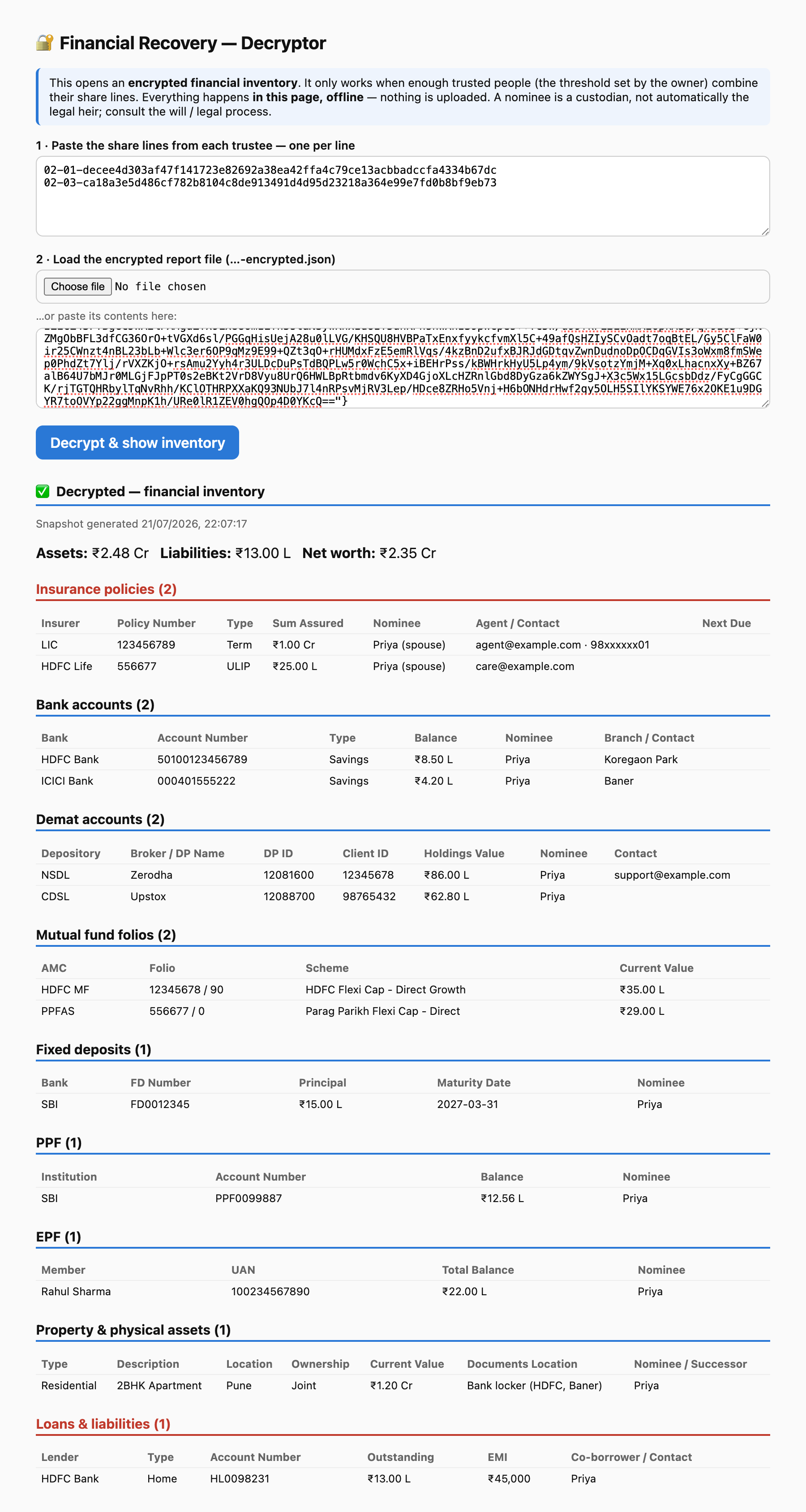
The inventory you're holding may be a summary (account numbers partly hidden for safety). The complete detail was encrypted on purpose, so that it could only be opened when genuinely needed — by several trusted people together, none of whom can open it alone.
To open it:
- Find the list of trustees (in the inventory or the will). You need at least the number printed on their share cards (often any 2 of 3).
- Ask those trustees to come together. Each holds one share card.
- They follow the printed For a trustee guide — it walks them through opening the encrypted file. It takes a few minutes and needs only a web browser.
- Once opened, they'll have the full inventory to share with you — it looks like this:
You do not need any password yourself — the trustees' shares are the key.
5. If you get stuck#
- The family lawyer / executor named in the will can coordinate all of the above and is the right person to lead the legal process.
- The inventory lists contacts for most institutions — start there.
- Keep the death certificate handy (multiple certified copies) — nearly every claim needs it.