Legacy / Estate Planning
The "hit by a bus" problem: if something happens to you, can your family find and access your finances? This system solves it in three layers of increasing protection. It complements a will — it does not replace one. In India a nominee is a custodian, not automatically the legal heir; succession still runs through the will / legal process.
- Layer 1 — Inventory & nominees
- Layer 2 — Trusted contacts & summaries
- Layer 3 — Encrypted split-key report
- Distribution checklist
Layer 1 — Inventory & nominees#
Record nominees and contacts on every relevant tab (Bank, FD, PPF, EPF, Insurance, Demat Accounts), and use the Property and Loans tabs so the picture is complete — including debts, which families most often miss.
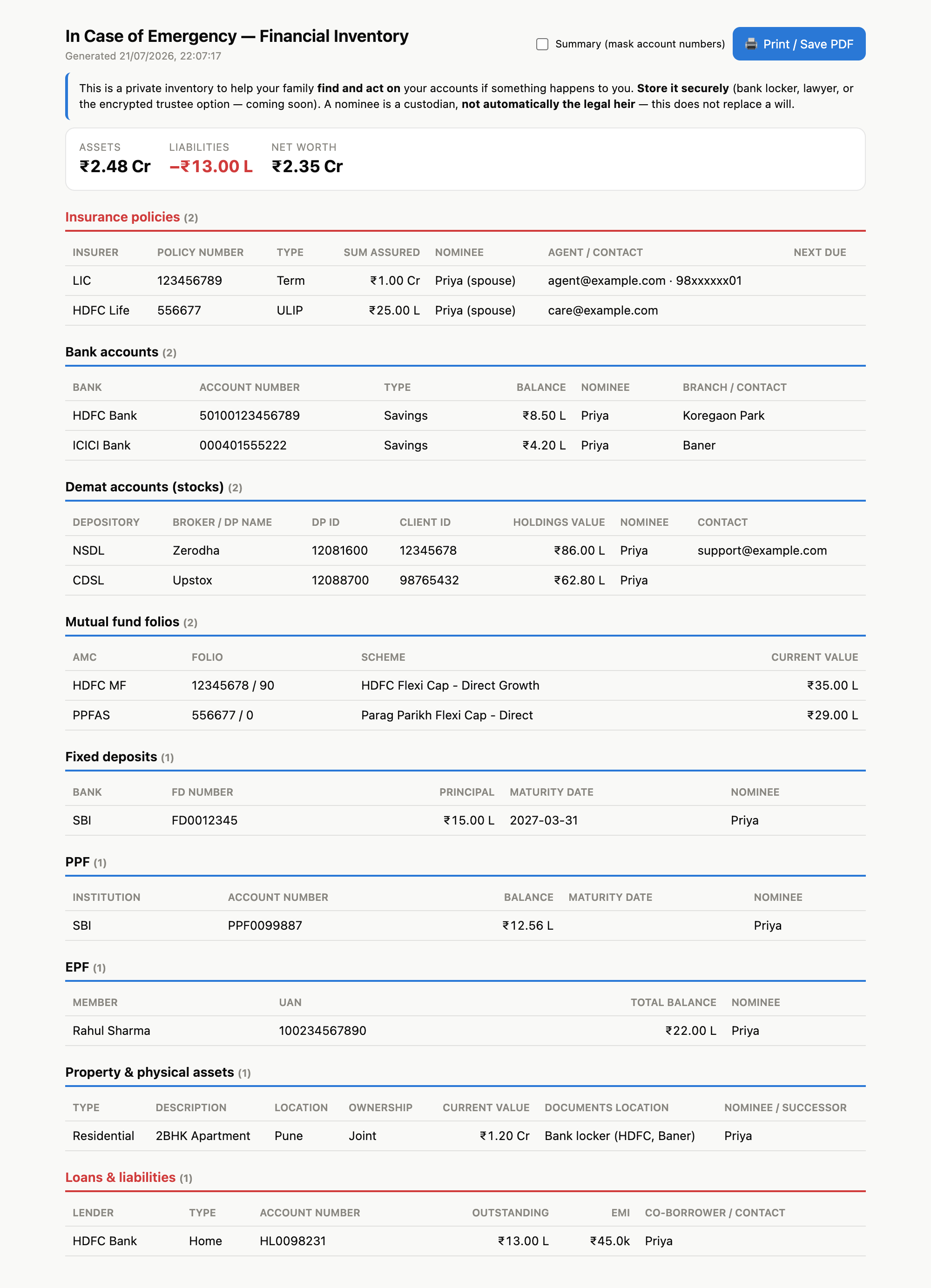
🆘 Estate / ICE report (menu) renders a printable "In Case of Emergency —
Financial Inventory": every account, policy, folio, property, and loan with its
nominee and contact, with Insurance and Loans highlighted. A Full/Summary
toggle masks account numbers (••••1234) in Summary mode. Print / Save-PDF
and store it in a bank locker or with your lawyer.
This layer has zero cryptographic risk and delivers most of the real-world benefit on its own.
Layer 2 — Trusted contacts & summaries#
👪 Trusted contacts & summaries (menu) manages the Trustees tab and emails a periodic overview. Only two safe levels are ever emailed:
- High-level — institutions + nominees only (no account numbers, no amounts).
- Summary — masked account numbers (
••••1234) + amounts.
Full detail is never emailed — email is the weakest channel (stored, forwarded,
breached). Full detail is reserved for Layer 3. You can Preview, Send now,
or schedule monthly / quarterly auto-sends (requires the script.send_mail
scope — a one-time re-authorization).
Layer 3 — Encrypted split-key report#
🔐 Generate encrypted trustee report (menu). This encrypts your full inventory and splits the decryption key among trustees so that any k of n together can open it — and no single person, or server, ever can.
How it works#
- A random 256-bit AES key is generated in your browser.
- Your full inventory is encrypted with AES-256-GCM (Web Crypto).
- The key is split into n shares with Shamir's Secret Sharing; any k reconstruct it, fewer reveal nothing. Default 2-of-3, shares only.
- You get three artifacts:
- the encrypted
.json(safe to store/share — useless without k shares), - n printable share cards (auto-labelled from your Key-Share-Holder trustees), and
- the standalone offline decryptor.
- the encrypted
The key never leaves the browser and is never stored.
Rotate vs Refresh (key lifecycle)#
The generator has two modes:
| Mode | Key | Cards | Use when |
|---|---|---|---|
| Rotate | brand-new random key | all new — redistribute | revoking/replacing a trustee, or periodic rotation |
| Refresh | reused — you paste k of your own shares | unchanged, no redistribution | routine data updates, same trustees |
In Refresh, you paste k existing shares and load the current encrypted file. The tool rebuilds the key in-browser, verifies it actually decrypts the current file (so mismatched shares are refused — no silently broken cards), then re-encrypts your updated data with the same key. Trustees' cards stay valid; you only swap the encrypted file.
Revocation#
Shamir cannot un-issue a single share. Revocation = rotation: generate a new key (new cards to the trustees you still trust), then replace/destroy the old encrypted file everywhere. The removed trustee's old share can't decrypt the new file.
Honest caveat: if a revoked trustee kept a copy of the old encrypted file plus their old share, they can still decrypt that old snapshot. You can rotate forward; you cannot claw back access to data someone already had a copy of. This is true of any encryption system.
The offline decryptor#
Decryptor.html is a standalone, self-contained tool: inline crypto, no
network, no dependency on this app, Google, or Anthropic surviving. A trustee
opens it in any browser, pastes k shares + the encrypted file, and sees the
inventory.
- It is common to all users and safe to be public — it contains no secrets, no keys, no data, only the algorithm (Kerckhoffs's principle: security lives in the key, never in the tool's secrecy).
- Recovery must use the offline file you distributed, never a tool fetched live at decrypt-time (a compromised host could serve a malicious decryptor). The file trustees hold has no such attack surface.
- Integrity: each share card prints the SHA-256 of the decryptor. A
trustee can verify their
Decryptor.htmlis genuine withshasum -a 256 Decryptor.html(or PowerShellGet-FileHash) before use.
Threat model#
Protects against: any party who isn't k trustees reading your full inventory — a single trustee, a breached inbox, a lost/shared encrypted file, a stolen Drive copy.
Does not protect against (and doesn't claim to): Google, which already hosts your Sheet — encryption protects the shared artifact, not your live data; retroactive deletion of copies someone already holds; collusion of k trustees (that's the intended unlock).
Activation is social, not automated. There is no dead-man switch — trustees combine shares when they judge the moment has come (realistically only a genuine emergency). Automated triggers are fragile (false fires on a trek with no signal; failures when actually needed) and deliberately avoided.
Crypto details#
- Cipher: AES-256-GCM via
crypto.subtle(confidentiality + integrity; random 96-bit IV per encryption; a wrong key fails the GCM auth tag). - Secret sharing: Shamir over GF(2⁸) (the AES field, poly
0x11b), evaluating a random degree-(k−1) polynomial per key byte. Share encoding:0k-0x-<hex>. - Independently tested: the sharing math reconstructs correctly across hundreds of random cases; too-few shares are rejected; the generator and the standalone decryptor (separate copies of the code) interoperate; and a refreshed report opens with the same cards.
Distribution checklist#
- Generate (Rotate) → download the encrypted
.jsonandDecryptor.html, and print the share cards. - Store the encrypted file + decryptor together where family can find them (Drive folder, bank locker, with your lawyer).
- Give each trustee their one card by a different channel than the encrypted file (hand it over, or a sealed envelope) — shares should not travel with the ciphertext.
- When your finances change, run Refresh (paste k of your shares) and replace the stored encrypted file — cards stay valid.
- To remove a trustee, Rotate and destroy the old encrypted file.
Role guides (print these)#
Plain-language, standalone guides written for each person who interacts with this — meant to be printed and included in your estate kit:
- For the owner — your maintenance & lifecycle duties.
- For your family — what to do first, in an emergency.
- For a trustee — how to unlock the encrypted report.
- For a nominee / beneficiary — nominee vs heir.
- For an executor / lawyer — administering the estate.